Prayer meeting invitations after a death, with a count for lunch
Share the prayer meeting, shraddhanjali, or bhog details in one link for every WhatsApp group. Family and friends reply in two taps without an account, and you know how many to cook for.
Free · No ads · No guest accounts
How do you invite people to a prayer meeting after a death?
Share one message with the person's name, the date and time, the place, and whether a meal follows, often in family WhatsApp groups first. Many families open with their own invocation, such as Om Shanti, Waheguru, or Jai Jinendra. With Hejmo, the details sit in one link, guests reply Yes, Maybe, or No without an account, and you see how many are coming for lunch. Memorial invitations are free and leave out party language.
Prayer meeting, shraddhanjali, bhog: what families call it
Families use different names, and the day varies by region and by family. "Prayer meeting" or "prayer meet" is the common English term, and shraddhanjali, a tribute of reverence, is used across India.
Punjabi Hindu families often hold a chautha or uthala within days of the death, with the rasam pagri on the fourth or thirteenth day. Many North Indian families hold the terahvi on the thirteenth day, and many South Indian families mark the eleventh to thirteenth day with a meal for relatives. Many Gujarati families hold a besnu, a few hours soon after the funeral when the family sits to receive visitors. People come briefly, so replies are rarely needed.
Sikh families gather for the Bhog and Antim Ardas, often at the gurdwara after a Sehaj Paath of about ten days or a 48-hour Akhand Paath, followed by langar. Many Sikh families also hold the rasam pagri at the Bhog. Jain families often gather to recite the Navkar Mantra.
Whatever the name, the invitation needs the same things: who, when, where, what to wear, and whether a meal follows.
Prayer meeting wording you can copy
Use your family's own invocation and terms, and keep Hindu and Sikh wording in separate messages.
Prayer meeting (shraddhanjali)
For a Hindu prayer meeting with a meal afterward.
Om Shanti. With love we invite you to a prayer meeting (shraddhanjali) for [Name] on [date] at [time] at [place]. Lunch will be served after the prayers. Kindly reply so we can plan the meal.
Bhajans and prayers
When the gathering is built around bhajans.
Please join us for bhajans and prayers in memory of [Name] on [date] at [time] at [place], followed by lunch. Kindly wear white or light colors.
Sehaj Paath Bhog and Antim Ardas
For a Sikh family gathering at the gurdwara.
The Sehaj Paath Bhog and Antim Ardas for [Name] will be held at [Gurdwara] on [date] at [time], followed by Guru ka Langar. Please cover your head.
Chautha and rasam pagri
For a Punjabi Hindu family.
The chautha and rasam pagri of [Name] will be held on [date] at [time] at [place]. Please join the family for prayers.
For a WhatsApp group
A short message to send with the link.
[Invocation]. [Name] left us on [date]. A prayer meeting will be held on [date] at [place]. All the details are in this link: [link]. Kindly tap yes or no so we can plan lunch.
What to include in a prayer meeting invitation
Clear details spare the family a stream of calls during a hard week.
The essentials
- Their full name
- The date, time, and how long the prayers will run
- The place, with the hall, temple, or gurdwara name
- Whether a meal follows
What to expect
- What to wear (often white or light colors)
- Covering your head at a gurdwara
- Whether flowers for the photo are welcome
- Whether it's open to everyone or family only
Replies
- A reply-by date for the kitchen
- Who to contact with questions
- How to join remotely, if the prayers are streamed
- A place for a short message to the family
Three steps to a count you can plan around
Set it up in a few minutes, share it where word is already spreading, and let the replies come to you.
Add the details and a few words about them
Name, date, time, and the address, plus what happens afterward. A few sentences about the person are enough.
Share one link, or one per household
Send the shared link by text, WhatsApp, email, or a Facebook post. For a private gathering, give each household its own private link instead. Nobody needs an account or an app.
See who's coming, and read their notes
Replies arrive with a headcount for the meal and any note a guest leaves for the family. A sibling or friend can co-host and watch the list with you.
Quiet by default, with their photo if you like
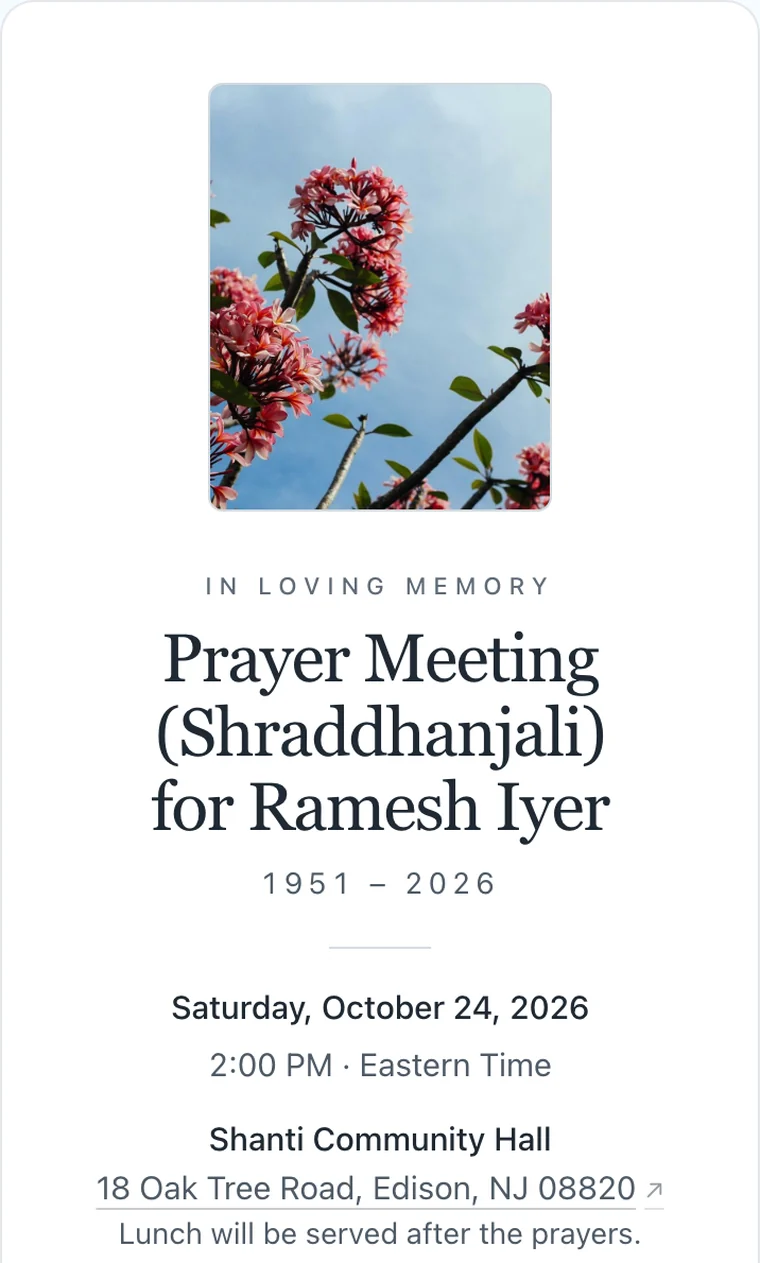
Every memorial invitation is free and leaves out party language. With $12 Plus Remembrance, their photo sits in a frame above their name. Mist, plain white with a simple frame, suits families who keep white for mourning.

IvoryWarm paper and an arched frame. The traditional choice. 
SlateDeep slate and pewter, for a formal or evening service. 
SageSoft green, an oval frame, and a small olive branch. 
MistPlain white with a simple frame. Suits any faith or tradition.
Who it's for
Best for
- Hindu, Sikh, and Jain prayer meetings after a death
- Families sharing details across WhatsApp groups
- A count for the meal after the prayers
- Relatives abroad who need the details and a way to reply
Not the best fit for
- Printed condolence cards
- Newspaper obituary notices
- Collecting donations
Easy on your guests.
They open the link and tap an answer. That's the whole ask. No account, no app, no phone number, and never an ad. Works on any phone.
Questions
Common questions about prayer meetings after a death.
What is a prayer meeting after a death?
A gathering, at home, in a hall, at a temple, or at a gurdwara, where family and friends pray, sing bhajans or kirtan, and offer condolences. It's often followed by a simple vegetarian meal.
What does shraddhanjali mean?
A tribute of reverence, also spelled shradhanjali. Families across India use it for a prayer meeting or memorial gathering, and it often appears on the invitation.
What should I wear to a prayer meeting?
White or light colors are customary. At a gurdwara, cover your head and remove your shoes.
What happens on the thirteenth day?
In many Hindu families the thirteenth day (terahvi in North India) closes the main mourning period with prayers, often a puja or havan, and a meal. Practice varies by family and region.
Should I bring anything?
Flowers for the photo are common. Ask before bringing food, since the family usually arranges the meal.
What does Hejmo do for prayer meetings?
Hejmo is an online invitation and RSVP link for an in-person prayer meeting. Memorial invitations are free, with no ads and no party language. Guests reply Yes, Maybe, or No in two taps without an account. They can add who's coming with them and leave a note for the family. You see a live count. Plus Remembrance ($12, once per event) frames their photo above their name, with "In loving memory" and their years.
Share it once, in every group
One link for every WhatsApp group, replies in one place, and a count for the meal. Free, with no ads.
Free · No ads · No guest accounts